The 2026 USA Pickleball rulebook is the authority for USA Pickleball play. It covers the serve, scoring, line calls, the non-volley zone and tournament procedures. This guide explains the rules players are most likely to use on court and highlights changes that can affect the outcome of a rally. If a tournament has an approved format or an on-court referee, follow that event’s instructions and the official 2026 rulebook.
Key Takeaways
- Side-out scoring remains the familiar format: only the serving team scores. Rally scoring is an optional tournament format in eligible events.
- Rally-scored games can now end on a receiving team’s winning rally: the former serve-to-win restriction was removed for 2026.
- Serve foot position is judged when the paddle contacts the ball: at least one foot must touch the correct service area, and neither foot may touch the court or an area outside that service area.
- In a game without line judges, players make their side’s line calls promptly: spectators must not be consulted. An opponent may call a service foot fault or non-volley-zone fault under the applicable procedure.
- One continuous, single-direction stroke may touch the ball more than once: that is not automatically a fault.
What Changed in the 2026 Pickleball Rules?
The official 2026 rule change document explains revisions and renumbered sections. Read it together with the current rulebook, because an older rule number may point to a different section in 2026.
Rally scoring and the winning point
When an event uses rally scoring, the team that wins a rally scores a point whether it served or received. Under the 2026 provisional tournament option, the receiving team can score the game-winning point on its rally. This is a change from the earlier serve-to-win restriction. Rally scoring is available at the tournament director’s discretion for eligible formats; it does not replace traditional side-out scoring everywhere. Check the event’s published format before play. See 2026 Rules 14.A.2 and 15.C.2.
More precise line-call and serve language
For non-officiated play, an “out” call must be made promptly. If a player returns the ball, the call must come before the opponent hits it or the ball becomes dead; if the player does not return it, a prompt call can still be recognized after the ball becomes dead. Spectators must not be consulted about calls. For a volley serve, the paddle must move in a clear upward arc at contact; the paddle head and ball-height limits must also be clearly met. See Rules 8.F, 8.J and 7.C.
Other changes players may encounter
A single player may contact the ball more than once if the contacts occur in one continuous stroke moving in one direction; a broken or reversing stroke, or both partners hitting the ball, is a fault (Rule 10.D). The 2026 book also adds a fifth round-robin tiebreaker based on points scored across all matches and expands its inclusive-play provisions. Tournament details belong to the official rulebook and event instructions.
Pickleball Basics
Court and net dimensions
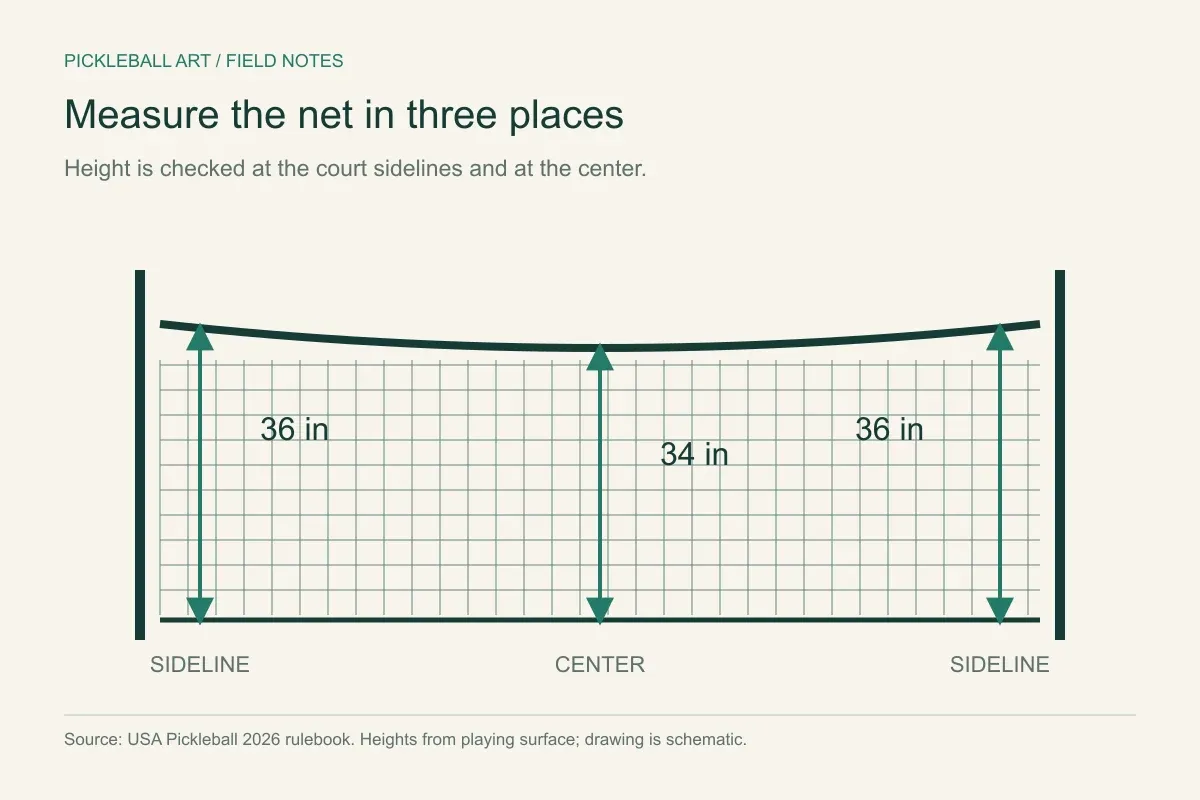
A standard court is 20 feet wide and 44 feet long for both singles and doubles. The net is 36 inches at the sidelines and 34 inches at the center. Each non-volley zone, often called the “kitchen,” extends seven feet from the net. The rest of each half-court has right and left service courts. The kitchen line belongs to the non-volley zone, so a serve touching that line has not cleared it.
The two-bounce rule
After the serve, the receiving side must let the ball bounce before returning it. The serving side must then let that return bounce before playing its next shot. After those two bounces, either team may volley when otherwise permitted. This rule is especially easy to forget when moving toward the kitchen line after serving.
Paddles and balls
For sanctioned events, check the current approved equipment list before using a paddle or ball. The USA Pickleball Equipment Standards Manual, currently a 2025 revision linked from the 2026 rules page, defines the size and surface requirements. A paddle may be no longer than 17 inches, and its combined length and width may not exceed 24 inches. Material names alone do not prove a particular model is approved.
Serving Rules in 2026
How to make a legal serve
- Start from the correct service area. At paddle contact, at least one foot must be on the ground behind the baseline in the correct service area; neither foot may touch the court or an area outside it (Rule 7.A). Standing a little farther behind the line gives you a margin of safety.
- Use a legal release. Do not deliberately add spin to the ball with your hand or paddle while releasing it. You may create spin when the paddle contacts the ball (Rule 7.B.2).
- For a volley serve, meet the contact limits. The paddle must move upward in a clear arc; its highest point must be clearly below the highest part of your wrist joint, and contact must be clearly no higher than your waist (Rule 7.C). A drop serve has its own requirements, so do not apply the volley-serve motion test to it.
- Serve diagonally. The ball must clear the non-volley zone and land in the diagonally opposite service court. It may touch the net on its way across if it otherwise lands correctly (Rule 7.E).
- Call the score and serve within the allowed time. Check the score, correct server and position before starting the point. You have one service attempt.
Singles and doubles serving order
In singles, serve from the right when your score is even and the left when it is odd. In doubles side-out scoring, the first serving team begins with one server; after the first side-out, both partners on a team normally have turns to serve before the serve goes to the opponents. Serving position follows the serving team’s score. In rally-scored events, verify the format’s serving and positioning instructions with the tournament director.
Common serving faults
Watch for a foot touching the baseline or outside the proper service area at contact, an illegal volley-serve motion, deliberate spin imparted during release, a serve into the kitchen or its line, and a serve outside the diagonal service court. If you are unsure about a close call, consult the current rulebook rather than relying on a remembered rule number from an older edition.
Scoring Rules
Side-out versus rally scoring
In side-out scoring, a team gains a point only on a rally it serves and wins. Games often go to 11, with a two-point winning margin; event formats can differ. In rally scoring, a point goes to the winner of each rally. The 2026 provisional option lets tournament directors use specified games to 11, 15 or 21 in eligible events. Some USA Pickleball events, including the listed Golden Ticket and National Championship events, are excluded from that option. Use the format announced for your match.
Can a receiving team win on game point?
Yes, if the match uses the 2026 provisional rally-scoring format. A receiving team that wins the final rally earns the point and may win the game. In side-out scoring, a receiving team that wins the rally gains the serve rather than a point. This difference is why players should confirm the scoring format before the first serve.
Round-robin tiebreakers
Under 2026 Rule 15.B.4, tied teams are ranked through the prescribed sequence: head-to-head match record; point differential across all games; point differential in head-to-head games; point differential against the next-highest team by wins; then total points scored across all round-robin matches. The final points-scored criterion does not apply across unequal-size pools. Check the complete rule and event instructions before calculating standings.
Kitchen, Faults and Line Calls
When is a kitchen fault called?
You may stand in the non-volley zone and hit a ball that has bounced. You may not volley while touching the zone or its line. Momentum after a volley matters too: if it carries you into the zone, the volley is a fault even if ball contact happened outside it. Re-establish your position outside the zone before another volley. The 2026 non-volley-zone rules appear in Section 11.
What about double hits and other faults?
A ball into the net, a ball out of bounds, a two-bounce-rule violation, or net contact while the ball is live can cost the rally. A double contact by one player is legal when it happens during a continuous stroke in a single direction. A discontinuous or reversing stroke, or two teammates both striking the ball, is a fault under Rule 10.D. Simply touching the ball twice is therefore not enough to decide the call.
Who makes line and fault calls?
In a non-officiated game, players are responsible for calls on their side of the court and should give the opponent the benefit of doubt on a close line call. Spectators must not be consulted. Rule 9.B.3 allows an opponent to call a service foot fault or non-volley-zone fault; if the teams disagree on one of those calls, the rally is replayed. Other suspected opponent faults may be mentioned after the rally but generally are not yours to enforce. When referees or line judges are assigned, their authority and review procedures apply instead.
Frequently Asked Questions
No. It is an optional, provisional format for eligible events. The tournament director and event rules determine which scoring format applies.
You may create spin when your paddle contacts the ball. You may not deliberately spin it with your hand or paddle during the release.
The relevant foot-position test is at ball contact: at least one foot must touch the proper service area and neither foot may touch the court or an area outside that service area.
No. More than one contact by the same player can be legal in one continuous, single-direction stroke. A second player striking the ball is a fault.
Use the official USA Pickleball rulebook and its change document. Tournament players should also check event instructions and ask the assigned referee when appropriate.
Play by the Current Rulebook
The 2026 rules retain the familiar court, kitchen and two-bounce fundamentals while clarifying how points, serves and calls work. The biggest practical scoring reminder is simple: in an eligible rally-scored event, a receiving team can now win on game point. For exact wording, exceptions and tournament procedure, consult the official 2026 USA Pickleball rulebook before play.