
The quickest way to follow a game is to understand how a rally starts, who can score and when you can hit without a bounce. This guide explains traditional side-out scoring under the current USA Pickleball rules. Ask before play whether your session uses a different approved format, such as rally scoring.
Use the official 2026 rulebook for exact wording and tournament procedure. The fuller current rules guide covers important format differences and revisions.

The court and the rally
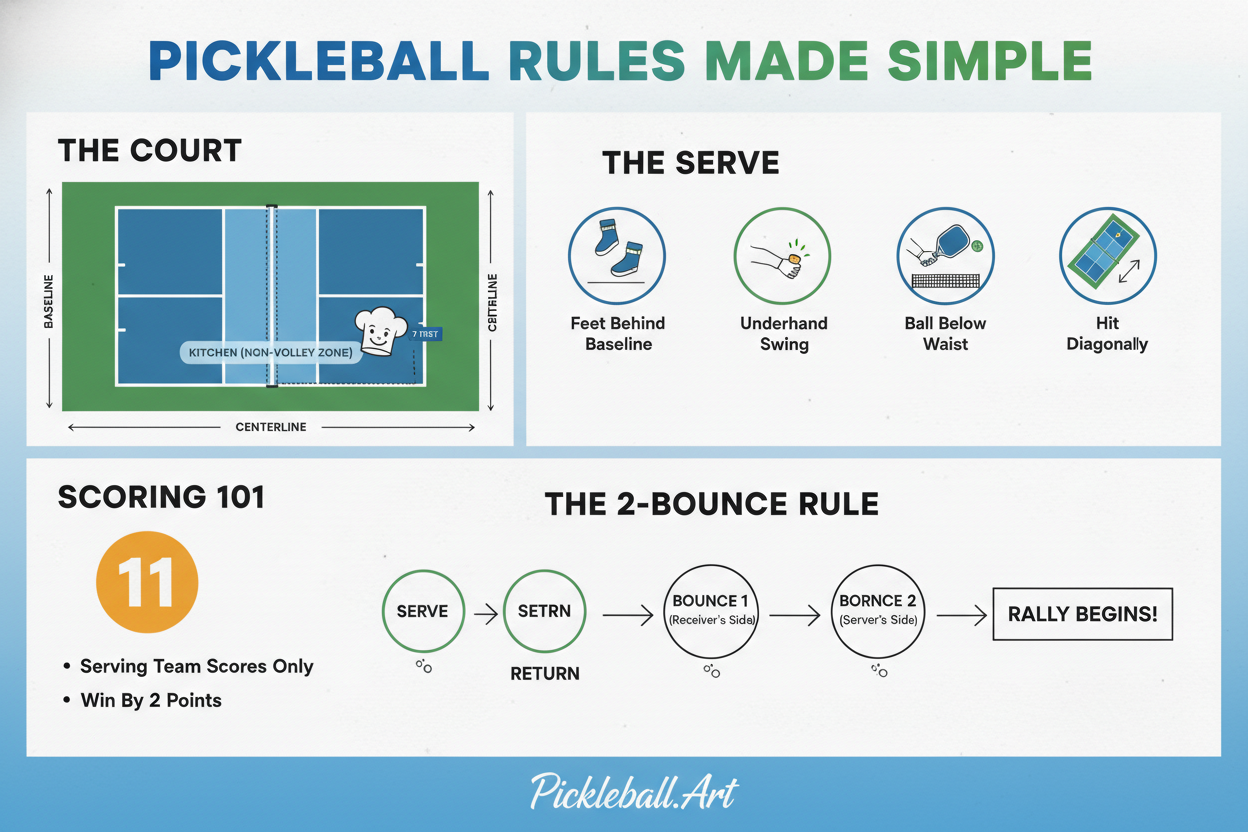
The court is 20 feet wide and 44 feet long for singles and doubles. The non-volley zone extends seven feet from the net on each side. Right and left service courts lie beyond it.
Return the ball over the net into the opponent's court before it bounces twice. A ball out, a failed return or another fault ends the rally. Under side-out scoring, a serving-side win earns a point; a receiving-side win takes away the current server's turn rather than earning a point.
Serve into the diagonal service court
At contact, at least one foot must touch the ground in the correct service area behind the baseline. Neither foot may touch the court or an area outside that service area. The serve must clear the kitchen and its line and land in the diagonal service court. You have one attempt.
A volley serve must meet the current upward-motion, paddle-head and contact-height requirements. A drop serve has different conditions: the ball is released without prohibited propulsion, then struck after a bounce. Do not deliberately add spin during release; spin from legal paddle contact is permitted.
A serve can touch the net and remain valid if it lands correctly. A ball touching the kitchen line on the serve is short and a fault. The receiving service court's other boundary lines are in.
Let the first two required shots bounce
The receiving team lets the serve bounce before returning it. The serving team then lets that return bounce. After those two bounces, either team may volley when permitted by the kitchen rules. This is different from allowing the ball to bounce twice on one side, which normally loses the rally.
Respect the kitchen and volley momentum
A volley is a hit before the ball bounces. Do not volley while touching the kitchen or its line. Momentum from a volley cannot carry you into it, even after the ball becomes dead.
You may enter to play a bounced ball. After touching the zone, re-establish both feet outside before another volley. The fault is not limited to the instant of paddle contact. See the kitchen examples for the footwork sequence.
Call the doubles score and follow the sequence
In traditional doubles, call three numbers: serving team's score, receiving team's score and the current server number. A common opening call is 0–0–2 because the first serving team has only one server's turn. After that opening side-out, each side normally gets both partners' turns before losing service.
Winning a point means the same server serves from the alternate service court. Losing a rally means the next server takes over or a side-out occurs. The server number refers to that service turn; it is not a permanent label for a player.
In singles, the server uses the right service court when their score is even and the left when it is odd. Games commonly go to 11 with a two-point margin, although event formats can differ.
Make clear, fair calls
In non-officiated play, make line calls promptly on your side and give opponents the benefit of doubt. Do not ask spectators to decide a call. Faults and disagreements have their own rule procedures; they are not all handled by replaying the rally.
Before your next game, confirm the scoring format and practice a few serve-return sequences. Clear partner communication helps share responsibility, but no unsupported percentage should be used to promise fewer errors.
Frequently Asked Questions
No. Traditional side-out scoring awards points only to the serving side. Rally scoring is a different format.
Yes, when you are not making a prohibited volley. After touching the zone, re-establish both feet outside before volleying.
No. The server number describes the current service turn, not a permanent identity.