Stronger pickleball play depends on reliable ordinary shots, balanced movement and deliberate choices. Returns, dinks, drops and resets deserve regular practice before adding an Erne or around-the-post shot. An advanced-looking shot is useful only when the ball and your position make it a reasonable option.
An Erne is a volley made from outside the non-volley zone near a sideline. An ATP, or around-the-post shot, sends the ball around the net post rather than over the net. Neither shot is a requirement for a 4.0 rating, and neither replaces consistency or partner coverage.
Moving from consistent recreational play toward stronger competition requires shot selection, placement and coordinated movement. Ernes and around-the-post shots are useful options when the ball and position allow them, but ordinary dinks, returns and resets remain the foundation.
Key Takeaways
- Optional attacking shots: An Erne or ATP can use an available angle. Recognize the opportunity and the rule limits rather than attempting one in every rally.
- Footwork and balance: Prepare for the opponent’s contact, use manageable steps and maintain a position from which you can recover.
- Purposeful drills: Give each practice a clear target, record errors and adjust the pace to your current control.
- Observe patterns: Watch the opponent’s preparation and previous choices, while staying ready for a different shot.
- Practice safely: Use a manageable drill pace, warm up and establish reliable footwork before adding difficult angles or jumping movements.
Understanding the 4.0 Level in Pickleball
A rating describes a range of abilities; reading a strategy guide does not establish one. Use the official rating framework or the system used by your event. For practice planning, examine your consistency, placement, movement and doubles decisions.
What defines a 4.0 player?
Focus on whether your shot choices fit the ball you receive. Can you return with useful depth, keep a dink controlled and decide when to reset rather than force an attack? These are more useful questions than whether you can occasionally make a spectacular winner.
Review forehand and backhand control, serve and return consistency, third-shot choices, volleys and movement with your partner. A drop that works in a cooperative drill may be less reliable under pressure. Practice it at several speeds and against different placements rather than assuming it is mastered.
Footwork should help you reach the ball while remaining balanced. Optional Erne and ATP practice comes after you have a manageable movement pattern and enough clear space.
From Power to Precision: A Squash Player's Pickleball Epiphany
A player moving from another racket sport may need to adjust court positioning and swing size. Develop compact contact and patience before trying to finish every point with pace.
Key skills needed to progress to 4.0
Start with the ordinary shot that most often limits your rallies. A focused session might pair a controlled third-shot drop with the next defensive reset, or a return of serve with balanced movement toward the non-volley-zone line.
Keep the paddle ready and pay attention to the incoming ball. Practice preparation and recovery with a partner at a pace that permits controlled contact. Increase pace when the movement and placement remain manageable.
Discuss poaching with your partner before trying it in a match. Moving across to take a ball creates an opening elsewhere, so agree who covers the vacated space. Choose the movement by ball position and recovery needs rather than chasing every possible interception.
Finally, practice mental toughness by simulating match point scenarios against strong competitors. Set clear goals for each session. For example, aim to land six consecutive drops before missing or redirect ten successful volleys cross-court without errors.
Mastering the Erne Shot
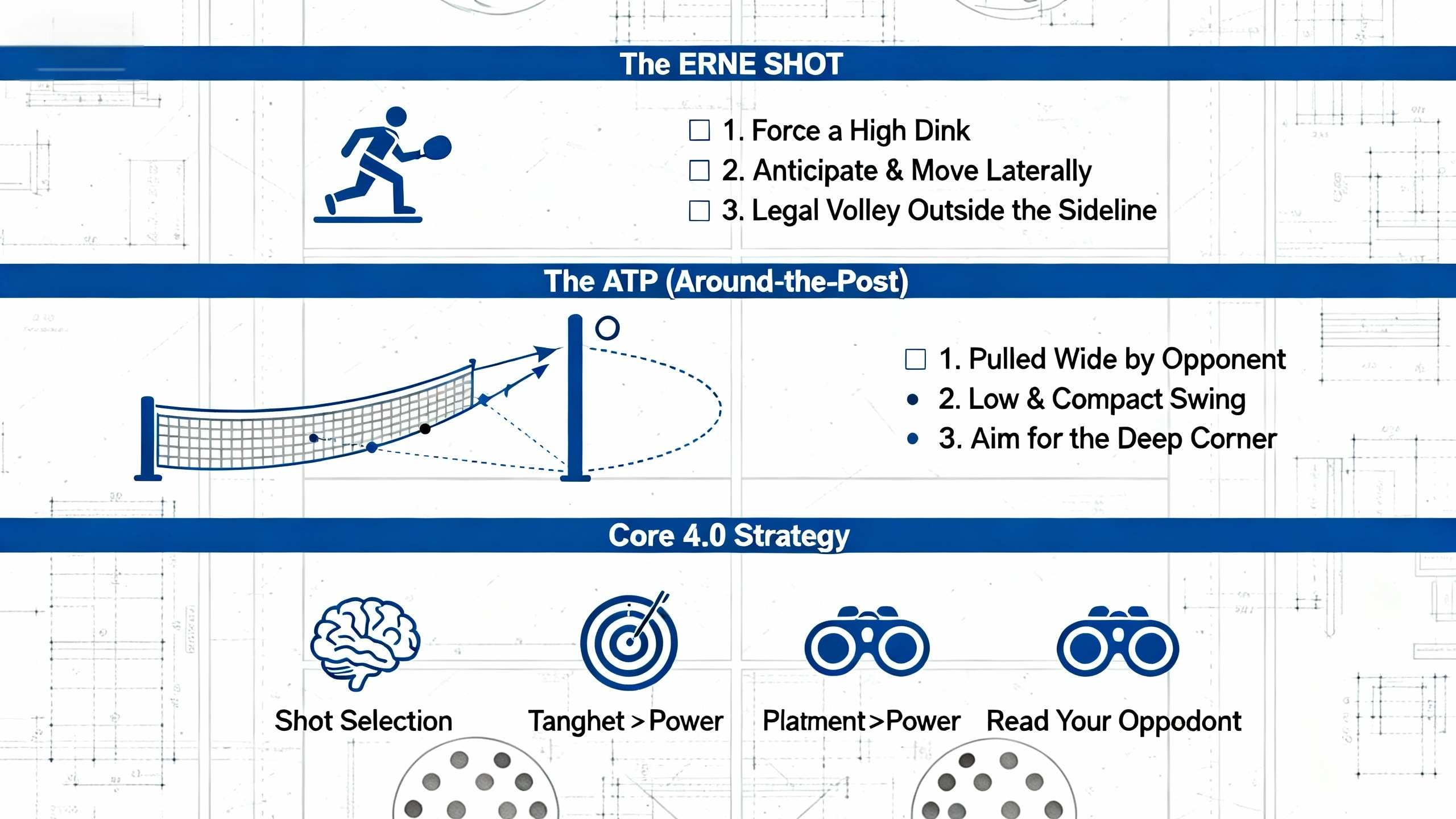
An Erne uses the space outside the sideline to make a volley near the net. It requires a suitable ball, legal non-volley-zone positioning and a recovery plan with your partner. Walking around the zone is one approach; jumping is not mandatory.
What is the Erne shot?
An Erne is a volley from outside the non-volley zone beside the court. A player may move around the zone or jump across it without touching it during the volley. The non-volley-zone line counts as part of the zone, and momentum into it after the volley is a fault.
If you have touched the non-volley zone, establish both feet completely outside it before volleying. Avoid contact with the net or net posts while the ball is live and follow the current net-plane restrictions. Check the official rulebook for the complete requirements and exceptions.
Footwork and positioning for the Erne
- Select a starting position from which you can move outside the sideline without leaving your partner an unmanageable gap. Standing closer to the net is not automatically better if it removes your recovery space.
- Stay aware of the non-volley-zone line. A controlled preparation step can help you change direction without inadvertently touching the zone during a volley.
- Rehearse the lateral movement at low speed. Use a step pattern that keeps your balance rather than forcing a powerful jump.
- Anticipate your opponent's paddle movement to gauge timing accurately. Watching their preparation gives you crucial information on how to position yourself.
- Step outside the sideline as you prepare for the Erne shot while maintaining balance. This slight adjustment helps ensure smoother execution.
- Create opportunities by strategically placing yourself near the corners of the court; good positioning opens up chances for surprise attacks.
- Practice the movement on each side where your usual forehand or backhand can make controlled contact. Learning to play with the opposite hand is not required.
- Focus on quick resets after each shot; efficient lateral movement allows you to maintain court coverage and remain ready for your opponent's response.
Timing and execution tips
- Observe your opponent's eyes and paddle face. This often tells you where they plan to hit the ball.
- Wait for the right moment before executing the Erne. Lure your opponent into hitting a high dink by applying pressure, then pounce.
- Use deception effectively. Fake a step toward the middle to create open lines down the sideline where you can execute the Erne.
- Use cooperative sideline feeds to learn which ball paths make an Erne available. A particular dink direction does not guarantee the next opportunity.
- Contact a ball you can reach and control from a legal position. Avoid stretching so far that your momentum carries you into the non-volley zone.
- Keep contact on your side of the net for the ordinary Erne situation. The official rules define net-plane exceptions; do not assume that going outside a sideline removes those restrictions.
- Stay aware of your footwork; do not step out too early or overcommit, as this can leave your side of the court vulnerable.
- Practice hitting the Erne from both sides diligently; becoming comfortable on your forehand and backhand enhances your skill and flexibility on the court.
After each attempt, check contact, foot position and recovery. A missed opportunity can be allowed to pass if attempting it would leave you off balance.
Perfecting the ATP (Around-the-Post) Shot
To perfect the ATP shot, position yourself close to the sideline. It's crucial to focus on your grip and swing to strike the ball cleanly as it curves around the post. Work on anticipating your opponent's trajectory and speed for better execution. When done correctly, this shot can surprise them and earn you valuable points.
Understanding the ATP
The ATP, or Around-the-Post shot, is a powerful tool in your pickleball arsenal. It allows the ball to travel around the net post rather than over it, which is often unexpected. You execute this shot at a low trajectory, making it incredibly tricky for opponents to return.
An ATP opportunity usually arises when a wide ball gives you a path around the post and back into the opponent’s court. Move under control and use a compact contact. A shot that travels around the post still has to land in bounds.
When and how to use the ATP shot
- Identify sharp angles: Use the ATP when your opponent forces you wide off the court at a sharp angle. Look for this opportunity as their shot approaches.
- Allow the wide ball to develop a usable angle while leaving enough time to make controlled contact. Waiting longer is not always better; the available path and bounce determine the opportunity.
- Maintain clear space: An ATP commonly takes you outside the sideline. Keep away from the net and posts and avoid entering the opponent’s court while the ball is live.
- Master compact swings: Keep your swing controlled and compact for both accuracy and power. This technique helps ensure a clean hit while maintaining paddle control.
- Read opponent's trajectory: Anticipate how your rival aims their shots based on their stance and paddle position. Use this knowledge to prepare for potential ATP opportunities.
- Consider the recovery: A wide ATP can leave a large gap on your side. Agree how your partner will cover the next ball if the opponent returns it.
- Practice wide-angle dinks: Build up your technique by practicing wide-angle dinks during drills. These will help you develop crucial skills needed for effective ATP execution.
- Aim within court boundaries: Ensure that every ATP shot lands inside the court lines without hitting the net; precision is vital in achieving success with this shot.
Practice recognizing a usable angle as well as making the shot. A controlled recovery or ordinary return may be the more sensible choice when the angle is poor.
Shot Selection Strategies for Advanced Players
Strategic shot placement can completely change the flow of a game. It's essential to assess your opponent's position and choose shots that capitalize on their weaknesses. Ultimately, balancing aggression and control keeps you in charge during intense matches.
Importance of strategic shot placement
Strategic shot placement gives you a distinct advantage during rallies. For instance, strong returns of serve create immediate opportunities for controlling the point. You must position yourself effectively to read your opponent's paddle position, especially when transitioning to the kitchen.
Use a reset shot to regain control in chaotic transitional rallies. Executing the fourth shot effectively helps keep opponents back while applying pressure. Focus on speed and precise placement from the kitchen line instead of relying on raw power.
Match aggression to the contact height, available space and your ability to recover. A fast attack from an unstable position may give away control instead of creating pressure.
Balancing aggression and control
Aggressive play, often set up by low dink shots, creates valuable offensive opportunities. However, you must maintain control while looking for these openings. Position yourself well to hit the Erne shot when the moment is right, but use patience to wait for those instances where aggressive plays can truly shine.
On the other hand, controlled, well-placed shots allow you to capitalize on your opponent's mistakes effectively. Assess your opponent's tendencies during matches. This ongoing assessment helps determine when to unleash a powerful shot or when to hold back and remain defensive.
Deception and misdirection are key tools in achieving this balance between aggression and control, making your gameplay more unpredictable and highly effective at the 4.0 level in pickleball.
Drills to Improve Key Shots
Practice specific drills to sharpen your Erne and ATP shots. A great method is to use cone targets on the court to improve accuracy and shot placement. Focus intensely on your footwork during these exercises. This dedication will help you hit those challenging shots with confidence.
Erne shot drills
Begin with slow, cooperative feeds and a clear sideline area. Record whether errors come from timing, contact, a zone fault or recovery before increasing pace.
- Rehearse a balanced preparation step near the non-volley-zone line, keeping the line and net in view.
- Practice stepping around the non-volley zone before a controlled volley. Check that both feet have re-established outside it if you previously touched the zone.
- Set up cross-court dinks with a partner to create Erne opportunities. These simulated plays enhance your timing and familiarity with high-pressure situations.
- Practice on both sidelines using your ordinary forehand or backhand as appropriate. Increase difficulty only while maintaining control.
- Reset quickly after each successful Erne execution. This keeps you prepared for incoming shots, maintaining optimal court coverage.
- Use cooperative partner feeds to refine your timing and positioning. Consistent feed drills allow you to focus entirely on perfecting the mechanics of the shot.
- Incorporate deception drills into your practice routine. Disguising your setup adds complexity, making it harder for opponents to anticipate your next move.
ATP shot drills
Use controlled wide feeds to learn the ATP angle. Clear obstacles around the sideline before starting and stop when chasing a feed would become unsafe.
- Pair up with a partner and drill wide-angle dinks. Create more ATP situations by hitting the ball to the sides of the court.
- Let the ball travel wide enough to create a path around the post, then make controlled contact before its second bounce.
- Focus on compact swings during practice sessions. Maintain proper paddle face orientation for improved accuracy in each shot.
- Simulate match play while alternating between defensive shots and attempting ATP shots. This scenario prepares you for real-game conditions.
- Emphasize footwork drills to boost your speed and positioning off the court; quick movement can lead to better ATP opportunities.
- Practice making contact on your own side and keeping clear of the net, posts and opponent’s court. Consult the rulebook for net-plane exceptions instead of treating every crossing as the same fault.
- Use targeted placement drills to ensure every ATP shot lands inside the lines; effective placement increases your chances of winning points.
- Incorporate reaction drills designed to read opponent's shots quickly; anticipate when an ATP chance arises, giving you an edge over competitors.
General accuracy and placement drills
Set a target appropriate to your current control, then record placement and mistakes. The drills below are practice suggestions rather than a validated route to a particular rating.
- Practice deep returns of serve to develop your accuracy and control. Aim for specific spots on the court, targeting the corners or midline.
- Drill low and controlled dinks that land in designated kitchen targets. This will help you master finesse shots while keeping pressure on opponents.
- Work on reset drills to block fast-paced shots back into the kitchen area. Position yourself well, so you can absorb the power while maintaining shot quality.
- Alternate between soft drops and aggressive drives during practice sessions. This strategy adds variety to your game and keeps your opponents guessing.
- Focus on split-step timing as you prepare for each shot. A quick reaction improves your movement and readiness to execute plays effectively.
- Execute fourth shot scenarios in drills to keep opponents back while pressuring their returns. Anticipate where they might play next; this prepares you for quick responses.
- Incorporate footwork ladders into your training routine to enhance agility and precision in placement. Speedy feet allow you to reach tough shots quickly while maintaining balance.
- Practice defensive blocks under pressure during mock matches or drills with a partner. Staying calm will boost your consistency during high-stakes rallies.
Review the recorded errors after practice. Change one target, movement or pace at a time so you can judge whether the adjustment helps.
Adapt Your Decisions During a Match
Observe how the opponent responds to repeated situations and discuss patterns with your partner. Treat a pattern as a working hypothesis rather than a certainty about the next ball. Choose aggression when you can maintain placement and recovery.
Reading your opponent's tendencies
Observing your opponent closely is a cornerstone of any effective 4.0 pickleball strategy. Recognizing their patterns allows you to exploit weaknesses and control rallies.
- Watch their footwork. Sudden or inefficient changes in movement often signal their next shot, allowing you to anticipate where they might hit the ball.
- Watch the paddle preparation and the ball together. Paddle height alone cannot reliably identify the next shot.
- Body position can suggest whether an opponent is stretched or balanced, but it does not establish their intended shot. Keep your own preparation flexible.
- Notice which contact positions produce weaker returns in this match. Test the pattern with controlled placement rather than assuming every player has the same weak side.
- Track the outcome of similar rallies throughout the match. Successful shots reveal what works for them—and what doesn't.
- Mix up your shot selection based on their tendencies. Varying your shots keeps them guessing and disrupts their rhythm.
- Communicate with your partner during play; share insights about your observations to enable coordinated responses against opponents.
Smart decision-making under pressure
Success at the 4.0 level requires strong decision-making skills under pressure. During intense rallies, every choice counts and can be the difference between winning and losing the point.
- Anticipate your opponent's moves and adjust your positioning quickly. Reading their body language helps you predict where they will hit the ball next.
- Focus on shot selection that balances aggression and control. Decide whether to attack or play safe based on your comfort and position on the court.
- Simulate high-pressure situations during drills with a partner who challenges you to mimic game scenarios that raise stress levels.
- Develop mental toughness through regular practice in tough conditions. Staying composed helps you make better choices during matches.
- Use spin strategically to throw off aggressive opponents' timing; it can help force mistakes when they least expect it.
- Maintain awareness of the transition zone; playing here requires quick thinking and smart placement to win key rallies against your opponent.
- Cultivate a mindset focused on outmaneuvering rather than overpowering opponents; strategic manipulation often leads to success over raw power at this level.
In pressure drills, discuss the decision after the rally: what ball was available, which option you chose and whether recovery was possible. Use that feedback to plan the next practice.
Frequently Asked Questions
A useful 4.0 practice plan emphasizes reliable shot placement, balanced movement and doubles decisions. Ernes and ATPs are optional tools when the ball and position permit them, not rating requirements or guarantees of winning.
An ATP is available when the ball travels far enough wide to create a path around the net post. Make controlled contact before the second bounce and return the ball into the opponent’s court. Respect net-contact, net-plane and court-entry restrictions.
Risks include poor contact, a ball out of bounds, a non-volley-zone volley fault, contact with the net or posts, and leaving space uncovered. For an Erne, momentum that carries you into the non-volley zone after the volley is also a fault.
Mastering shot selection is paramount at the 4.0 level because opponents are skilled enough to capitalize on predictable patterns. Relying on the same shot repeatedly creates easy opportunities for them. Smart shot selection involves mixing up speeds, spins, and placements to keep your opponent off-balance, disrupt their rhythm, and create offensive openings.
Consistency, placement and sound decisions deserve priority over isolated advanced shots. Assess the full range of skills against the rating system used by your event; mastering an Erne or ATP alone does not establish a 4.0 rating.
Conclusion
Use this guide to select a small, specific practice goal. Start with an ordinary shot and its recovery, then add an Erne or ATP situation only when the movement and rule requirements are clear.
Review what actually happened in practice: placement, balance, missed opportunities and partner coverage. A useful drill makes those decisions easier to examine; it does not guarantee match results.
Work on one or two skills at a manageable pace and compare the errors over successive sessions. For more practice ideas, see the at-home control drills.
Check the current USA Pickleball rulebook for non-volley-zone, net-post and ball-contact restrictions.