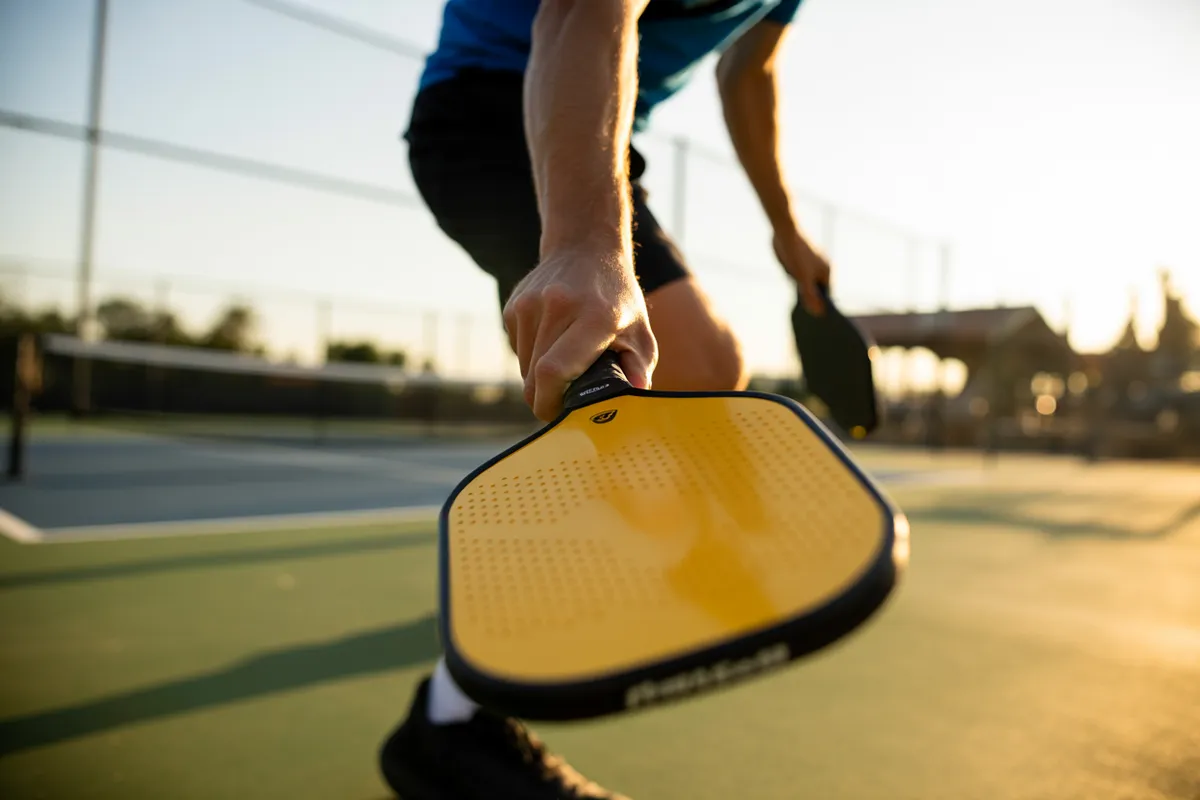
Your grip sets the relationship between your hand and the paddle face. A small rotation can change the angle of contact even when the swing feels the same. Begin with a comfortable neutral hold, then make deliberate adjustments for the shots you practice. These are coaching cues to explore, not a single correct grip for every hand and style.
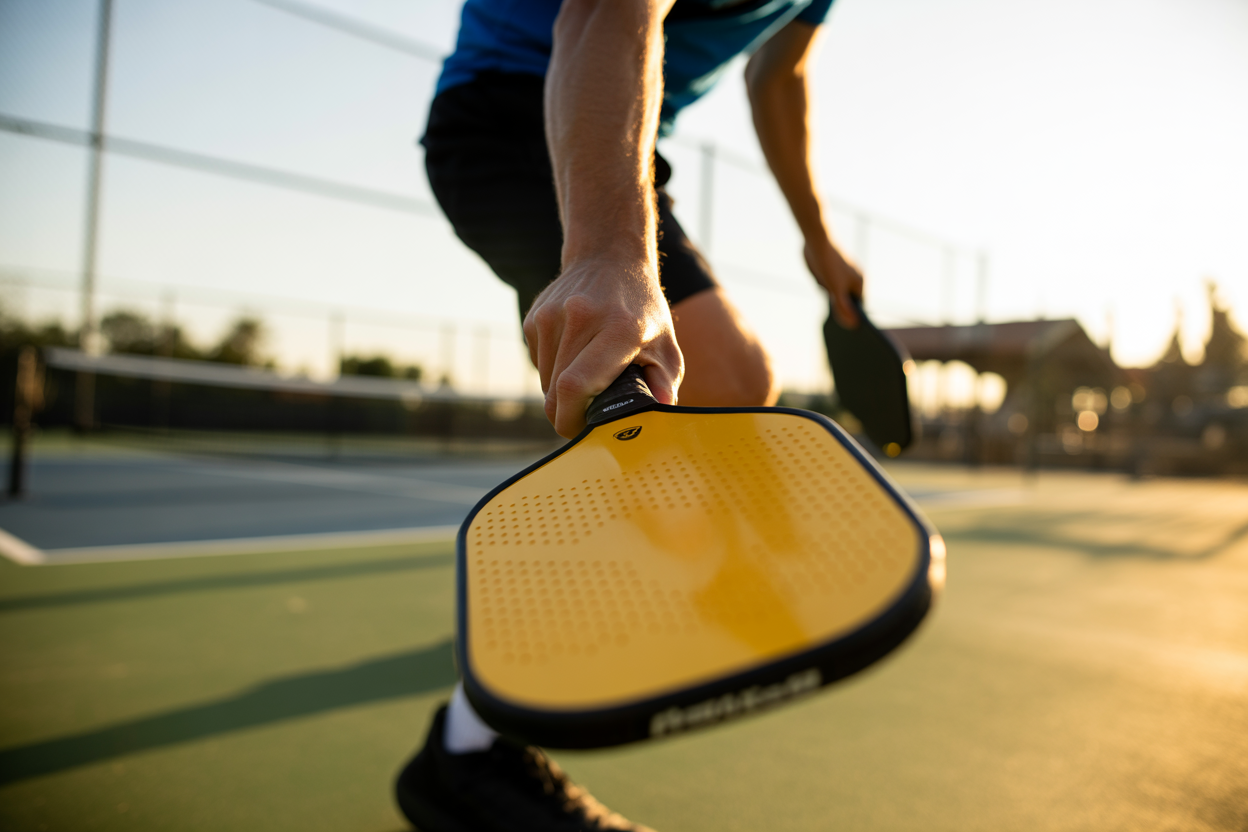
Find a neutral starting hold
Hold the paddle with its face roughly vertical and take the handle as if holding a hammer. Wrap your fingers comfortably and let the thumb rest alongside them. This is commonly called a continental grip. Check that you can present the face on both forehand and backhand without making a large last-second rotation.
Handle bevel numbering assumes a particular hand and orientation, so a visual demonstration is often more useful than memorizing a number. Left-handed players mirror right-handed demonstrations. If a bevel cue leaves the face awkwardly open or closed, check the starting orientation.
Use enough pressure to hold the paddle securely
A continuous hard squeeze can make it difficult to vary touch. Too little pressure allows the handle to move unexpectedly. Use a secure but relaxed hold in the ready position, then adjust to the incoming ball. Describing pressure on a ten-point scale is a teaching cue, not a measured force or medical recommendation.
Try short, gentle dinks and notice whether the face stays stable. Then compare blocks against moderate pace. The goal is repeatable contact without clenching throughout the rally; it is not to hit every shot with identical pressure.

Understand forehand-oriented grip changes
An eastern forehand grip rotates the hand from the neutral hold toward the forehand side. More rotation produces grips often described as semi-western or western. These can suit a player's forehand contact and swing path, but they also change the adjustment required on the backhand and at the net.
Change one thing at a time. Hit a short series of forehands, then backhands and volleys. If the adjustment helps one shot but repeatedly opens or closes the face on another, decide whether you can switch reliably at game speed before adopting it.
Check handle fit and the two-handed backhand
A handle should allow a secure hold without crowding the fingers. Test the actual grip circumference with any overgrip you use. Two-handed players should place both hands on the usable handle and check clearance through a slow swing. There is no universal handle length that fits every hand.
A worn, wet or loose grip can change security. Replace or dry it when its condition requires, following the product instructions, rather than waiting for a fixed number of playing hours. A grip change does not diagnose or treat wrist or elbow pain.
Build a repeatable practice sequence
- Set a neutral ready position and check the face angle.
- Hit gentle forehand and backhand dinks with the same starting hold.
- Try controlled blocks and notice unwanted handle rotation.
- Compare a forehand grip adjustment with the neutral hold.
- Return to the ready position after every shot.
Use a partner or a suitable practice wall, with space clear of other players. Keep your movement slow while learning. For construction and fit choices, see the paddle selection checklist. The official rules govern legal play; grip names themselves are coaching terminology.
Frequently Asked Questions
No. It is a common neutral starting point. Choose and practice a hold that lets you control the face through your shots.
Use enough pressure for a secure hold and adjust to the shot. Constant maximum pressure is not a useful default.
Inspect it for wear, looseness and persistent slipping. Sweat, use and the material matter more than a universal hour count.