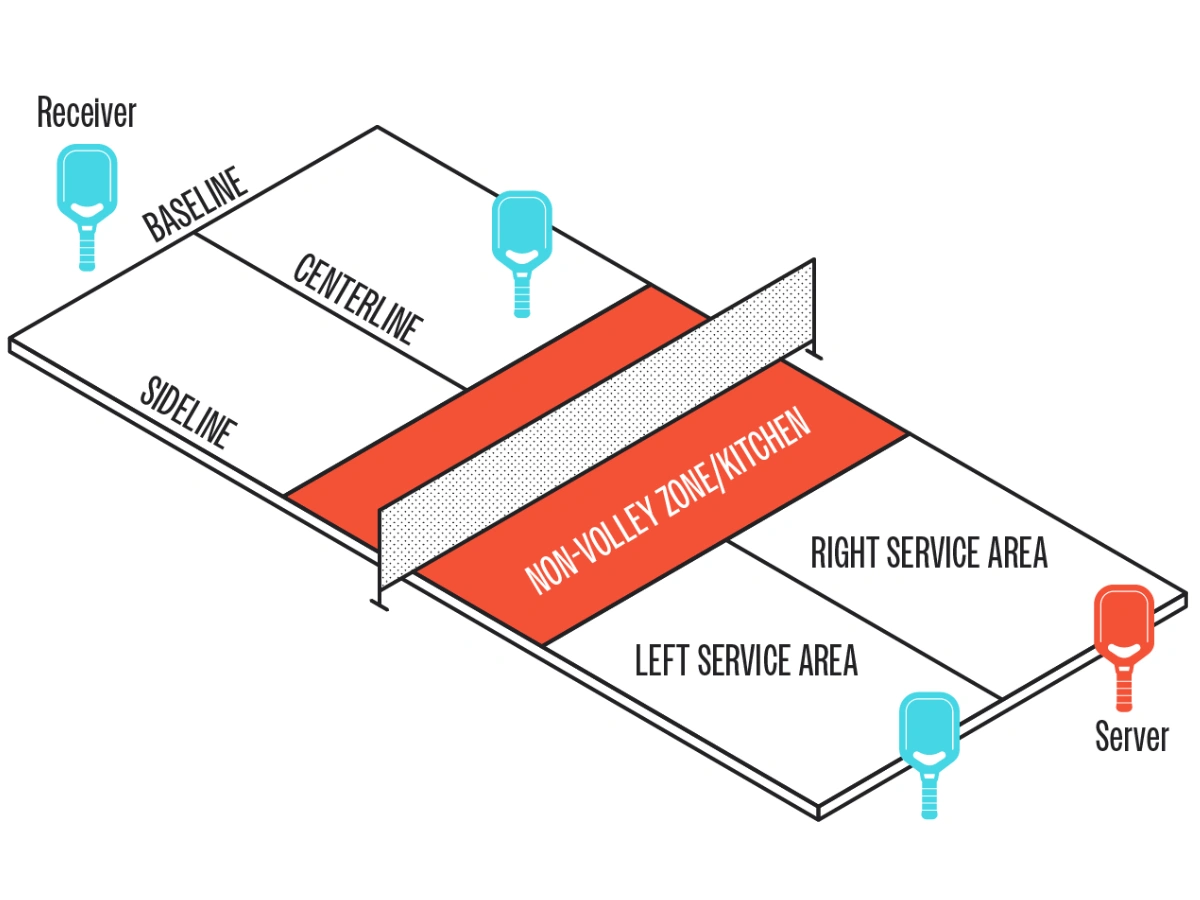
A useful beginner doubles strategy follows the rally in order: serve, return, third shot, reply and transition. You do not need a highlight shot for each stage. You need to understand who must let the ball bounce, who can move forward and when to pause before hitting.
The framework below is coaching guidance, not a rule requiring every team to play the same way. For partner calls, middle-ball decisions and a shared practice plan, use the doubles communication guide.
Know the two rules that shape the opening
The receiving side must allow the serve to bounce, and the serving side must allow the return to bounce. After that, volleys are permitted outside the non-volley zone. A volley is a shot played before the ball bounces. These requirements are explained in the USA Pickleball rules summary.
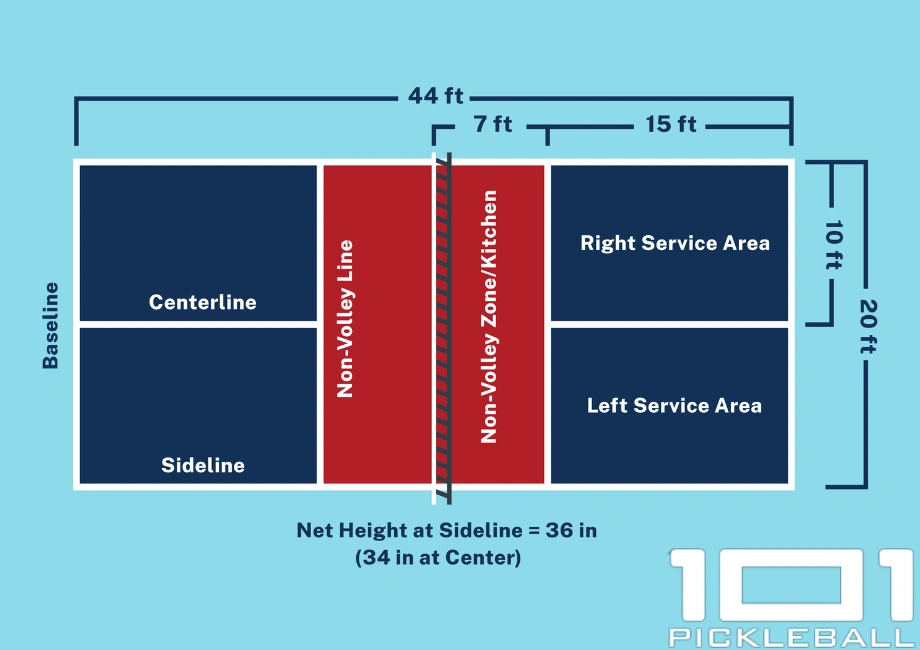
The kitchen restricts volleying, including contact with its line and entry caused by a volley's momentum. You may enter it to play a ball after a bounce. Distinguishing “after a bounce” from “before a bounce” matters more than memorizing a slogan about never stepping into the kitchen.
Shot one: give the team a playable serve
A serve that lands legally begins the opportunity to play the point. Choose a target with margin inside the correct service court. Trying to paint a line can trade a potential advantage for a fault, particularly while your serve is still inconsistent.
The server and partner should be ready for a deep return that has to bounce. A sensible beginner starting position keeps both serving players far enough back to avoid being caught by that return. Do not rush to the kitchen merely because the serve looked strong.
Shot two: return with time to establish position
A deep return can keep the serving team back and give the receiver time to move forward. Aim inside the baseline with enough height to stay reliable. The receiver's partner can begin near the kitchen line while the receiver starts in a position suited to returning the serve.
After the return, move toward the kitchen when the ball and your balance permit it. Slow down as the opponents are about to hit. Arriving slightly later with a controlled stop is often more useful than sprinting forward into the next ball.
Shot three: choose a path toward the kitchen
The third shot is the serving team's reply to the return. A drop attempts to send a softer ball into the opponents' kitchen; a drive sends a firmer shot that may create a less comfortable reply. Neither is automatically the right choice in every rally.
| Situation | Reasonable option | Main priority |
|---|---|---|
| You are balanced behind a comfortable ball | Try a controlled drop or a purposeful drive | Choose a target with margin |
| The return is deep and stretches you | Send a controlled defensive ball | Recover balance before advancing |
| The opponents remain back | Use the available space | Avoid forcing a kitchen drop without need |
| You are still learning the soft shot | Practice the drop separately | Build repeatability rather than chasing a perfect arc |
If the third shot lands high, pause instead of following it blindly. The opponents may attack. If it creates a softer reply, advance together as much as the next ball allows. The goal is a controlled transition, not a race to a painted line.
Shots four and five: read the reply before moving again
The receiving team can maintain its advantage by keeping the reply controlled and making the serving team hit from a difficult position. A low ball is often better placed safely than swung at aggressively. A high ball can offer an attacking opportunity, but consider the available angle and your balance.
The serving team should decide whether the next ball permits another forward step or requires a reset. A reset is a softer defensive reply intended to reduce the opponents' attacking opportunity. Stop moving during contact when possible, then reassess the next ball.
Protect the middle while moving as a pair
When one partner moves far to the side, the other usually needs to shift toward the exposed middle. Staying planted in your own half can create a gap opponents can use. Do not chase your partner's exact position; preserve useful spacing and a shared view of the court.
Call “mine” or “yours” early enough to affect the decision. When both players reach the kitchen, keep the paddle prepared and make small adjustments. For more specific middle-ball agreements, see the partner communication checklist.
Practice the sequence without keeping score
Play cooperative serve-return-third-shot rallies. Pause after the third shot and discuss whether it created a safe chance to move forward. Repeat with a deeper return, then with a shorter one. This isolates the decision you are learning from the emotion of winning or losing.
When games resume, choose one focus: a reliable return, a balanced transition stop or a clear middle call. Record the type of error rather than making up a success percentage. Once the first five shots feel organized, stacking and switching can be explored with a fuller understanding of the rally.
Doubles court-position illustrations
Visual examples of equipment and court settings. Images are illustrative; current specifications and fit should be checked with the maker or retailer.
Frequently asked questions
Should both partners run to the kitchen after serving?
No. The serving team must let the return bounce. Start ready for that bounce, play the next shot and advance when the ball and your balance create an opportunity.
Is a third-shot drop always better than a drive?
No. The decision depends on ball height, your balance, opponents’ positions and the shot you can control. Practice both and choose a purposeful option with enough margin.
Can I stand in the kitchen while a ball bounces?
Yes. The non-volley zone restricts volleying and related momentum. You may enter to play a bounced ball, but must satisfy the volley rules before hitting a later ball out of the air.